Starting a business in Japan can feel intimidating at first. The language is different, the paperwork can look dense, and a lot of advice online is either too vague, too theoretical, or already outdated.
But the truth is this: Japan is not impossible. In many cases, it is actually more structured and predictable than people expect. The real challenge is not that the process is unworkable. The challenge is knowing which path to choose, which steps matter first, and which mistakes are expensive but avoidable.
Let’s see how to start a business in Japan the right way.
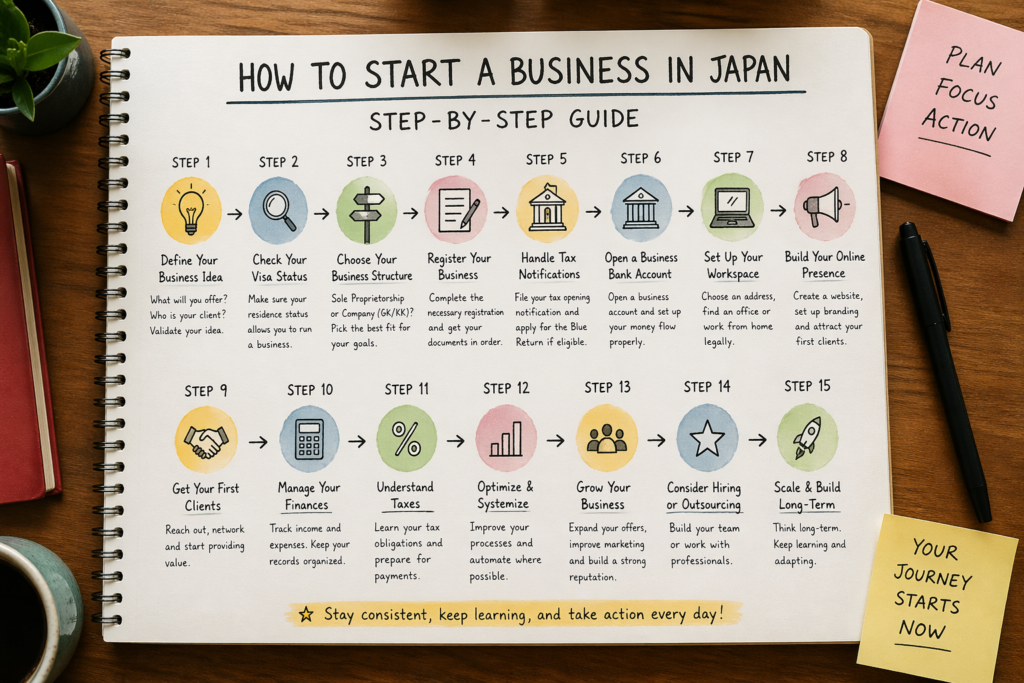
This guide is designed to help you do exactly that.
Whether you are already living in Japan and want to start freelancing, or you are planning to build a larger company, this article will walk you through the practical decisions that matter: choosing between sole proprietorship and a company, handling the first registrations, understanding the tax basics, opening the right accounts, and building a setup that can actually grow. Japan’s official tax authority requires specific filings when you start operating, and JETRO’s current setup guidance also frames the process around company registration, tax notices, bank account opening, and—where relevant—visa steps.
Step 1: Decide what kind of business you are actually building
Before you touch any paperwork, you need to answer one simple question:
What are you really trying to build?
A lot of people jump straight into questions like:
- “Should I create a GK?”
- “Do I need a company seal?”
- “Which bank should I use?”
- “Can I get a visa?”
Those questions matter, but they come after the bigger one.
You first need to define:
- what you will sell,
- who you will sell it to,
- where your customers are,
- how you will get paid,
- and whether you are testing a small activity or building a scalable company.
This matters because Japan gives you more than one way to operate. Broadly speaking, you can operate as an individual business owner, incorporate a company, or—if you are an overseas firm—set up a branch or representative structure. JETRO’s setup materials explicitly distinguish these operating forms and their legal treatment.
A practical rule
For most first-time founders already living in Japan and legally allowed to work, the simplest starting point is usually:
- sole proprietorship if you are testing a service business, freelance activity, consulting offer, small e-commerce operation, or side business,
- company if you need a stronger structure from day one—for example because you need partners, a more formal image, easier contract handling, future hiring, or a business structure tied to financing, equity, or more complex operations.
That is partly a business judgment, but it is also reflected in the setup burden: individual businesses mainly start with tax notifications, while companies require incorporation and legal registration first.
Step 2: Make sure your residence status allows what you want to do
This step is often skipped, and it can become a serious problem.
If you are already in Japan, your status of residence matters. Some people are in a very flexible position from the start—for example if they have permanent residence, spouse-based residence, or another status that allows broad work activity. Others are not.
If your ability to stay in Japan depends on the business itself, then immigration becomes a central part of the startup process, not an afterthought.
This is especially important if you are thinking about the Business Manager route. Japan’s Immigration Services Agency has revised the standards for this status, and the current official materials now reference requirements including at least one full-time employee and business assets of 30 million yen or more, with supporting documentation. The same official page also expects documentation around Japanese-language capability. In other words, you should not rely on older blog posts that still repeat older thresholds without checking the current immigration guidance first.
What this means in practice
If you are:
- already in Japan with work rights,
- starting small,
- and testing an activity,
then your first business problem is usually not immigration. It is choosing the right structure and getting operational.
If you are:
- outside Japan,
- trying to relocate through the business,
- or building a business specifically to support a residence application,
then you should treat immigration strategy as one of your first decisions, not your fifth.
That distinction saves people months of confusion.
Step 3: Choose between sole proprietorship and a company
This is one of the most important decisions in the whole process.
Option 1: Sole proprietorship
This is usually the fastest and lightest way to begin.
You are not creating a separate legal entity. You are operating as an individual who has started a business activity. In Japan, the National Tax Agency provides the filing route for new individual business owners through the business opening notification, and related tax filings such as the blue return application.
This route is often a strong fit if you are:
- a freelancer,
- consultant,
- creator,
- translator,
- service provider,
- affiliate publisher,
- coach,
- solo online business owner,
- or someone validating a market before scaling.
Advantages:
- faster to start,
- less bureaucracy,
- lower setup friction,
- easier for lean operations.
Disadvantages:
- less formal image in some contexts,
- no separation between you and the business,
- can become messy as revenue, risk, and operations grow.
Option 2: Company (usually GK or KK)
Japan’s setup framework recognizes company incorporation as a standard path, and JETRO’s official setup flow explicitly frames legal registration as a core step before starting operations. It also notes that a company can be incorporated with as little as 1 yen in capital under the current legal framework, although that does not mean 1 yen is a sensible real-world choice.
If you are thinking long term, the two forms most foreign founders discuss are:
- GK (Godo Kaisha) — often seen as simpler and more flexible,
- KK (Kabushiki Kaisha) — often seen as more traditional and more formal in perception.
You do not need to over-romanticize this choice. In many small-business situations, the better question is not “Which is more prestigious?” but “Which one is proportionate to the business I am building right now?”
A practical recommendation
If you are launching a service business alone and want speed, testability, and lower friction, starting as an individual business is often the cleanest move.
If you already know you want:
- a more formal structure,
- a stronger image for B2B contracts,
- a path to hiring,
- a partner structure,
- or a business whose legal identity matters from day one,
then a company may make sense earlier.
Step 4: Define your offer before you file anything
This sounds obvious, but many people start the legal side before they have a usable offer.
Before filing anything, write down:
- your service or product,
- your ideal customer,
- your pricing,
- your payment method,
- your acquisition channel,
- and your first 90-day goal.
That could be as simple as:
I help foreign residents in Japan with X.
I will sell in English.
My first goal is 10 paying clients.
I will get them through SEO, social media, referrals, or outbound outreach.
I will use Stripe, bank transfer, or another workable method depending on the platform.
This step matters because paperwork will not save a weak business model. It only formalizes it.
Step 5: If you start as a sole proprietor, file the basic tax notifications
This is where things become very practical.
Japan’s National Tax Agency lists the key notifications for individuals who newly start a business. The core one is the business opening notification. As of the NTA’s current guidance, the opening notification is due by the final tax return deadline for the year in which the business started. If you want the blue return benefits, you must separately submit the blue return approval application—generally by March 15 of the year you want to use it, or within two months of opening if you started after January 16. The NTA also allows these applications to be filed through e-Tax.
The filings to know first
For a new individual business owner, the most important first filings are:
- Business opening notification
- Blue return approval application, if you want blue return treatment
- potentially other related notices depending on your situation, such as family employee salary treatment
The exact package depends on your case, but those first two are the key ones for most solo founders.
Why the blue return matters
The blue return is not a small detail. It is one of the most important setup decisions for a real small business in Japan.
In practice, it often matters because it is tied to a more business-like bookkeeping approach and tax benefits, so serious founders usually want to understand it early rather than treat it as an afterthought. The National Tax Agency treats it as a separate approval procedure with specific deadlines.
Practical advice
Do not wait until tax season to “figure out the paperwork later.”
If you start operating, get your filing strategy clear early.
That one choice often separates people who feel in control from people who panic the following year.
Step 6: If you incorporate, understand the sequence
If you decide to incorporate a company, your process becomes more structured.
JETRO’s official setup flow describes the broader sequence around:
- company registration,
- opening a bank account,
- filing tax notices,
- and handling related personnel or visa matters where relevant.
At a high level, company setup usually means:
- choosing the legal form,
- preparing the company details,
- completing incorporation/registration,
- then handling tax, banking, office, and operations.
You do not need to know every tiny legal detail before starting. But you should have these core decisions ready:
- company name,
- address,
- business purposes,
- director/member structure,
- capital amount,
- fiscal year-end,
- ownership structure.
A practical note on capital
JETRO states that company incorporation in Japan is legally possible with as little as 1 yen in capital. That is a legal minimum, not a business recommendation. Realistically, your capital should reflect the business you are actually running and the credibility you need.
If you are building a real operating company, choose a capital amount that looks serious enough for your context and supports initial expenses.
Step 7: Set up a business address and working structure that makes sense
At this stage, many people get distracted by image.
You do not need a fancy office to start.
You need an operating setup that is:
- legal,
- usable,
- affordable,
- and consistent with the business you are actually building.
JETRO’s setup material explicitly treats office setup as one of the practical tracks in establishing a business base in Japan.
Think in stages
Stage 1: validation
- home office or simple working setup,
- low fixed costs,
- focus on revenue.
Stage 2: formalization
- better address,
- stronger presentation,
- better systems.
Stage 3: scale
- staff,
- contracts,
- operational processes,
- more formal infrastructure.
Too many founders buy “professional-looking” overhead before they have professional-looking revenue.
Step 8: Open the right accounts and get your money flow clean early
This is one of the most underestimated parts of starting a business in Japan.
Even if the legal setup is correct, a messy money flow creates stress fast.
You want separation between:
- personal spending,
- business income,
- business expenses,
- taxes you will owe later.
Your goal is not perfection
Your goal is clarity.
At minimum, you want:
- one main account for the business,
- a clean way to receive money,
- a clean way to pay business expenses,
- a system to track revenue and costs,
- a separate reserve for future taxes.
JETRO’s setup flow explicitly includes bank account opening as a practical step in business establishment.
Practical advice
Do not treat incoming revenue as “money I can spend.”
Treat it as:
- operating money,
- future tax money,
- and only then personal income.
That mental separation matters more than people think.
Step 9: Decide how you will get customers before you overbuild the business
This is where many founders make the biggest strategic mistake.
They spend weeks on:
- structure,
- seals,
- paperwork,
- website design,
- logo,
- bank options,
but they do not answer the question:
How will customers actually find me?
That is why you should define your acquisition channel early.
Examples:
- SEO
- social content
- referrals
- partnerships
- outbound email
- paid ads
- directory listings
- niche communities
For most small founders, the cleanest early question is:
What is the simplest channel that can bring the first 5 paying customers?
Not the first 5,000.
The first 5.
Because once you can sell, the paperwork feels much less frightening.
Step 10: Build the simplest website that can still convert
If your business needs a website, do not turn that into a 3-month design project.
Your first website only needs to do a few jobs:
- explain what you do,
- establish trust,
- show who it is for,
- make it easy to contact you or buy,
- and support your content if SEO is part of your strategy.
Your first site does not need:
- custom code,
- huge animation,
- ten menus,
- a giant resource center,
- complicated branding.
It does need:
- a clear homepage,
- a clear offer,
- 2–3 useful pages,
- contact details or CTA,
- basic trust signals,
- clean English if your audience is international.
That is enough to start.
Step 11: Learn the tax basics before your first profitable month
This is where people get hurt.
Japan’s tax system is manageable, but it is not forgiving if you ignore it.
JETRO’s setup resources include a dedicated tax section for doing business in Japan, and the National Tax Agency’s guidance for new business operators makes clear that certain tax-related notices arise as soon as a business starts.
At a practical level, you need to understand:
- that registration and tax are connected but not identical,
- that income and business expenses must be tracked properly,
- that the filing method matters,
- and that cash flow planning matters because taxes arrive later, not exactly when the money arrives.
A practical rule
From your first sales, get used to this habit:
- record income,
- record expenses,
- keep invoices and receipts,
- and reserve money for taxes.
If you do that from day one, your future self will thank you.
If you do not, your first serious tax season can feel much worse than it should.
Step 12: Keep records from the beginning
This is boring advice, but it is some of the highest-value advice in this whole guide.
Keep:
- invoices,
- receipts,
- contracts,
- screenshots of subscriptions,
- payment confirmations,
- bank records,
- and a simple ledger of income and expenses.
If you are on the blue return path, this matters even more because the whole logic is built around organized bookkeeping and proper reporting. The NTA’s blue return procedure is formal and separate; it is not just a cosmetic checkbox.
The easiest habit
Once a week:
- categorize expenses,
- check income,
- save digital documents,
- update one spreadsheet or accounting system.
One hour a week beats ten days of panic later.
Step 13: Know when to stay lean and when to formalize
A lot of founders assume that “serious” means “incorporated immediately.”
Not always.
Sometimes the serious move is:
- staying lean,
- validating demand,
- keeping costs low,
- and building real revenue first.
Other times, the serious move is:
- incorporating earlier,
- clarifying ownership,
- preparing for contracts,
- or building something that needs stronger legal structure from day one.
There is no universal answer. But there is a wrong answer: formalizing more than the business itself can justify.
Step 14: Use professionals selectively, not blindly
You do not need to outsource your entire brain to a scrivener, accountant, or consultant.
But you also do not need to do everything alone.
The best use of professionals is usually:
- for the parts where mistakes are expensive,
- where current rules matter,
- or where documentation quality really counts.
JETRO itself points users toward support services, setup resources, and directories of experts supporting foreign businesses in Japan.
Good uses of a professional
- immigration-sensitive cases,
- incorporation documents if your structure is more complex,
- tax setup if your situation is not straightforward,
- accounting if you are already making real money,
- employment setup once you start hiring.
Bad use of a professional
Paying someone to do basic thinking you should have done yourself:
- what you sell,
- who you serve,
- how you will get customers,
- and whether your business model actually works.
Step 15: Think in phases, not in one giant leap
This is one of the best ways to make the process feel manageable.
Phase 1: Validate
- define offer,
- start operating,
- get first customers,
- learn the market.
Phase 2: Formalize
- improve systems,
- register properly,
- clean up tax handling,
- create a more professional setup.
Phase 3: Scale
- strengthen brand,
- add acquisition channels,
- improve operations,
- hire or outsource,
- possibly change structure if needed.
This phased way of thinking is much more realistic than trying to build the final version of the business before the first version has earned anything.
Common mistakes to avoid
1. Starting with paperwork instead of a business model
If you do not know who pays you and why, paperwork will not save the project.
2. Assuming every founder needs a company immediately
Many do not.
3. Ignoring visa reality
If your residence status is part of the equation, do not treat it casually. Current Business Manager standards are more demanding than many older guides suggest.
4. Ignoring the blue return question
If you are operating as an individual, this is a major tax setup decision, not a minor detail.
5. Mixing personal and business money
This creates avoidable confusion very quickly.
6. Building a beautiful site before getting customers
A clean simple site is enough to start.
7. Waiting too long to organize records
The best time to become organized is before you “need” to be.
A realistic first 30-day action plan
If you want something concrete, here is a practical month-one roadmap.
Week 1
- define your offer,
- define your customer,
- decide whether you start lean as an individual or incorporate,
- check your residence-status implications.
Week 2
- choose your working setup,
- prepare your business identity,
- create a basic website or landing page,
- set up payment flow and records.
Week 3
- file the relevant startup notices if you are beginning as an individual business,
- or move forward with company setup if that is the right route,
- start contacting or attracting potential customers. The NTA’s current guidance lays out the key initial notices for new individual businesses, including the opening notification and the separate blue return application if applicable.
Week 4
- publish content,
- begin outreach,
- refine your pricing,
- and focus on getting the first real customer.
That first customer teaches you more than ten hours of administrative overthinking.
Final thoughts
Starting a business in Japan is not about mastering every administrative detail before you move. It is about building a business that is legally sound, commercially real, and operationally manageable.
If you remember only three things from this guide, make them these:
- Choose the right structure for the business you actually have now, not the fantasy version of it.
- Handle the early tax and legal steps properly, especially if you are starting as an individual or if immigration is involved.
- Do not confuse being busy with being in business—getting customers still matters most.
Japan rewards clarity, consistency, and seriousness.
You do not need to know everything on day one.
But you do need to move in the right order.